Steel corrosion is a major issue in bridges, offshore platforms, industrial plants, tanks, and general infrastructure because moisture, salts, and pollutants steadily attack exposed steel surfaces.
That is why zinc coating on steel remains one of the most widely used corrosion-control methods in industrial protection work.
The two most common decision routes are hot-dip galvanizing and zinc-rich coating systems.
Both rely on zinc for sacrificial protection, but they differ in process, repair strategy, system flexibility, and where they fit best in a project lifecycle.
Quick Guide
- Choose galvanizing for standard parts processed under factory-controlled conditions.
- Choose zinc-rich coating systems when structures are large, site-applied, or maintenance-intensive.
- Match the solution to corrosivity, access, and repair strategy, not only to upfront cost.
- Add epoxy and topcoat layers when barrier build, UV resistance, or longer atmospheric durability is required.
- Confirm surface preparation, DFT control, and recoat windows before final approval.
What Is Zinc Coating on Steel
Zinc coating on steel means applying a zinc layer or zinc-rich protective system to a steel substrate to reduce corrosion risk.
Its core value comes from dual protection: zinc acts sacrificially, and the coating system also helps isolate steel from moisture and oxygen.
In practical specification work, this can mean either a solid zinc coating formed by hot-dip galvanizing or a zinc-rich paint system used as part of a multi-layer coating design.
That distinction is critical because the protection method may be similar, but fabrication sequence and maintenance strategy are not.
Why Zinc Coating Matters
Corrosion is not only a surface appearance problem.
It directly affects structural reliability, maintenance frequency, shutdown planning, and lifecycle cost on industrial steel assets.
Zinc is widely used because it protects steel sacrificially, corroding before the substrate when exposure conditions allow galvanic action.
That is the reason zinc-rich primers are commonly specified on bridges, offshore steel, and other heavy-duty atmospheric assets.
A properly designed zinc-based protection route can support much longer service life than bare steel, but performance still depends on environment, system design, and inspection quality.
Compare Galvanizing and Zinc-Rich Coating
Hot-dip galvanizing is a plant process in which fabricated steel is immersed in molten zinc, while zinc-rich coatings are applied as paint systems by spray, brush, or roller. ASTM A123/A123M overview
That process difference usually drives the first design decision before price is even discussed.
Selection guidance
Choose galvanizing when:
- The components are standard and can be processed in a galvanizing plant.
- The project prefers factory-controlled zinc application.
- Low initial maintenance is the main objective.
Choose zinc-rich coating systems when:
- The structure is large, assembled on site, or difficult to galvanize after fabrication.
- Repairability and staged maintenance matter.
- The system also needs epoxy barrier coats and a UV-resistant finish.
Review the Main Zinc Technologies
Hot-dip galvanizing
Hot-dip galvanizing forms a metallurgically bonded zinc coating on steel products fabricated to final shape for corrosive service.
ASTM A123/A123M covers coating thickness, finish, appearance, and adherence requirements for hot-dip galvanized iron and steel products. ASTM A123/A123M overview
Zinc-rich epoxy coating
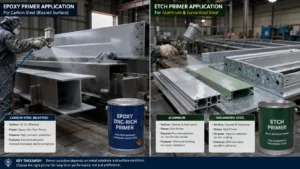
Zinc-rich epoxy primers contain a high concentration of metallic zinc in the dry film and are widely used as primer layers in heavy-duty anti-corrosion systems.
They are common on bridges, offshore steel, port equipment, and industrial structures where cathodic protection and maintenance flexibility are both important.
Inorganic zinc silicate coating
Inorganic zinc-rich primers are typically silicate-based and are often selected for high-demand atmospheric steelwork when the project can control surface preparation well.
They are also valued in some petrochemical or higher-temperature environments because of their heat and solvent resistance characteristics.
Build the Full System Around Zinc
A complete corrosion-protection system usually includes more than just zinc.
In many industrial specifications, zinc provides the first line of protection, while epoxy adds barrier build and topcoats provide weather resistance.
Typical material roles:
- Zinc primer: cathodic protection at the steel interface.
- Epoxy intermediate coat: barrier protection and chemical resistance.
- Polyurethane topcoat: UV resistance and exterior durability.
- Fluorocarbon topcoat: premium weathering and long-term appearance retention.
This is why buyers should think in terms of system architecture rather than a single zinc product.
For more detail on primer routes, HUILI’s zinc-rich primer guide is a practical reference for comparing epoxy zinc and inorganic zinc options.
Design by ISO 12944 Environment
ISO 12944 is widely used to align corrosivity category and durability planning with protective paint system selection for steel structures.
In that framework, durability refers to time to first major maintenance rather than a fixed warranty term.
A practical selection route is:
- C2-C3 exposure: zinc-rich primer plus epoxy plus PU is a common atmospheric system direction.
- C4 exposure: heavier barrier build and tighter preparation control are usually needed.
- C5-M and CX exposure: stronger zinc-based systems and closer inspection discipline are typically required for marine steelwork.
For projects mapping environment before system selection, HUILI’s ISO 12944 corrosion protection guide is the right internal starting point.
Match the Method to Industrial Applications
Galvanizing often fits smaller fabricated parts, repetitive components, handrails, brackets, and standard assemblies that can move through plant processing efficiently.
Zinc-rich coating systems fit large structural steel, bridges, tanks, marine equipment, and fabricated assets that need site touch-up or later repair access.
Typical application direction:
- Structural steel: zinc-rich systems are often preferred when field joints and future maintenance are expected.
- Offshore and marine steel: zinc-rich primer plus epoxy build plus durable topcoat is a common route.
- Tanks and pipelines: atmospheric external service should be evaluated separately from internal immersion or lining conditions.
- Industrial equipment: engineered coating systems are useful when geometry, repairability, and finish control matter.
Check Surface Prep and Inspection
Zinc-rich coatings are highly dependent on surface preparation, especially when inorganic zinc or heavy-duty systems are specified.
For prepared steel, HUILI recommends high-solids zinc-rich primers on Sa 2.5 or Sa 3 surfaces in higher-demand situations.
A practical inspection checklist should cover:
- Surface preparation standard before primer application.
- DFT control across flats, edges, welds, and repaired areas.
- Recoat interval control between zinc-rich primer, epoxy, and topcoat.
- Compatibility between zinc-rich primer and intermediate coat.
- Local repair method for damaged areas after transport or erection.
What buyers often forget:
- Large structures may be easy to specify for galvanizing but difficult to process logistically.
- Zinc-rich primers are not all interchangeable; binder type and topcoat compatibility matter.
- A strong zinc primer cannot compensate for poor preparation or weak inspection control.
Understand the Advantages of Modern Coating Systems
Modern zinc-rich coating systems are often chosen over galvanizing when projects need more flexibility in application stage, repair planning, and finish build.
They also allow the coating engineer to tailor the system around actual environment and expected maintenance strategy.
Key advantages include:
- Better fit for large or complex structures.
- Easier local repair during maintenance.
- More customization through zinc, epoxy, and topcoat combinations.
- Better control over appearance and UV durability when topcoats are required.
Choose the Right Solution
There is no single winner for every project.
The right choice depends on environment, component size, fabrication sequence, maintenance philosophy, and whether the system must be repaired in service.
Use this decision logic:
- Choose galvanizing for standard small-to-medium fabricated parts with factory completion and low early maintenance expectations.
- Choose zinc-rich coating systems for bridges, tanks, large structural frames, offshore steel, and projects needing site work or future repair.
- Choose zinc-rich primer plus epoxy plus PU when atmospheric corrosion, UV exposure, and maintainability matter together.
- Review inorganic zinc options when higher heat resistance or petrochemical service is part of the operating condition.
Prevent Common Selection Mistakes
One frequent mistake is over-specifying galvanizing on very large or awkward assemblies that will still need site welding, repair, or staged erection.
Another is treating all zinc-rich materials as equivalent without checking binder type, application conditions, and layer compatibility.
Other common errors include:
- Comparing only initial price instead of lifecycle cost.
- Using zinc-rich primer without the intermediate and topcoat layers needed for the real exposure.
- Applying atmospheric system logic to immersion or internal lining service.
- Ignoring inspection planning for DFT, repairs, and recoat control.
Conclusion
Both galvanizing and zinc-rich coating systems provide effective zinc coating on steel because both use zinc’s sacrificial behavior to reduce corrosion risk.
Galvanizing is often the better fit for factory-processed standard components, while zinc-rich coating systems are often the better fit for large structures, higher system flexibility, and long-term maintenance planning.
For many industrial projects, engineered zinc-rich systems offer a stronger balance of repairability, site practicality, and lifecycle control, especially when epoxy barrier coats and durable topcoats are part of the design.
FAQ
What is the difference between galvanizing and zinc coating?
Galvanizing is one type of zinc coating on steel applied by the hot-dip process, while zinc coating is a broader term that also includes zinc-rich paint systems.
How long does zinc coating on steel last?
Service life depends on environment, coating thickness, system design, and maintenance strategy.
In ISO 12944 planning, durability is expressed as time to first major maintenance.
Which is better: galvanizing or zinc-rich coating?
It depends on the application.
Galvanizing usually suits standard fabricated components, while zinc-rich coatings are often better for large structures and easier maintenance repair.
Can zinc coating be repaired?
Yes, but zinc-rich coating systems are generally easier to repair locally than galvanized surfaces after damage or field modification.
What is the best coating route for offshore steel?
A zinc-rich primer combined with epoxy barrier build and a durable topcoat is a common route for offshore and severe marine atmospheric steelwork.
Request a Coating Solution
Choosing the right zinc coating system affects corrosion performance, maintenance planning, and total ownership cost across the full service life of the asset.
Send your project environment, steel type, asset size, fabrication stage, surface preparation condition, drawings, and required durability through our contact page to get a suitable galvanizing-or-zinc-rich recommendation, plus TDS and documentation support.