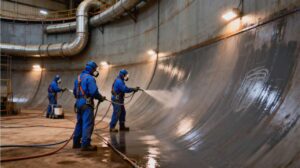
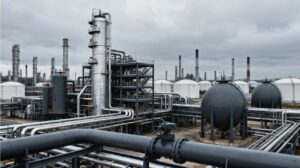
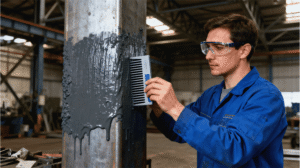
Industrial steel structure corrosion failures are usually caused by system selection errors—the environment is underestimated, the film build is under-designed, or the execution plan (surface prep + QC) cannot achieve the assumed performance. ISO 12944 helps engineers avoid this by requiring two inputs first: corrosivity category (C2–C5/CX) and durability class (L/M/H/VH, defined as time to first major maintenance).
Quick Guide: How to select the right system
Assess exposure: identify the ISO 12944 corrosivity category and whether it’s coastal, industrial, or high-humidity.
Define durability: set L/M/H/VH based on “time to first major maintenance” and shutdown strategy.
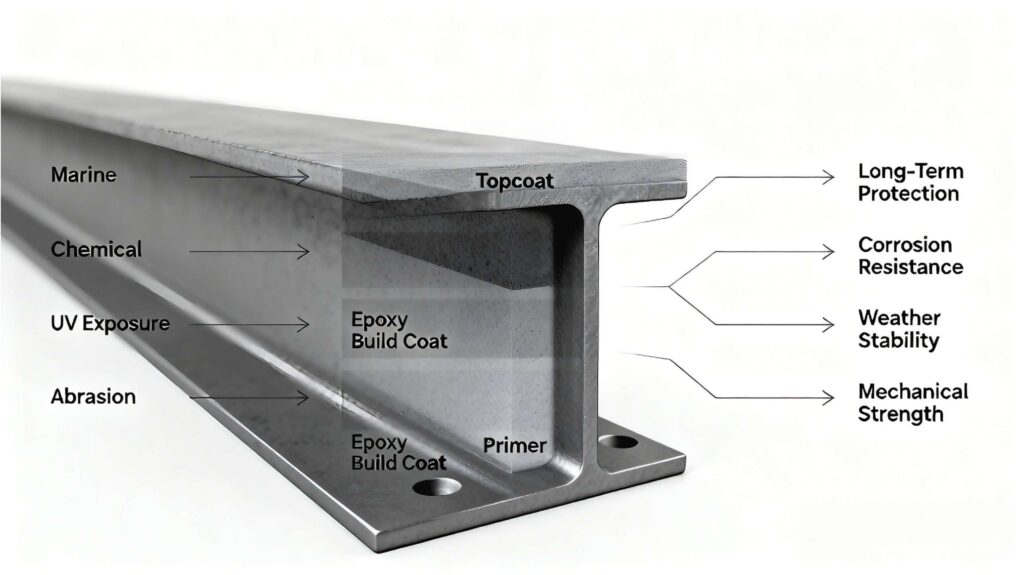
Select system family: use a 3-layer build (zinc-rich primer + epoxy barrier coats + UV-stable topcoat) for most outdoor steel, then strengthen for higher categories.
Lock execution: specify surface preparation, stripe coat at edges/welds, DFT targets by layer, and recoat-window control.
Where steel structures corrode first (and why)
Steel structures see very different service environments—from inland industrial atmospheres to coastal exposure—commonly described using ISO 12944 corrosivity categories. ISO 12944 examples show that coastal salinity and industrial pollution/humidity drive higher corrosivity, which in turn demands stronger coating systems and durability planning.
In real fabrication and erection, corrosion often initiates at geometry and detail points: edges, welds, bolted connections, cut-outs, and crevices. These locations are harder to coat evenly and are more sensitive to thin film build and surface contamination, so they need specification-level attention (stripe coats + targeted DFT checks).
Think in systems: primer + build coat + topcoat
A “single-product” mindset fails because corrosion protection is a layered function: the primer supports adhesion and corrosion inhibition, the intermediate coats build barrier thickness, and the topcoat provides weathering resistance and protects the barrier layers in service. HUILI’s steel structure guidance emphasizes coating as a system designed to extend service life and reduce maintenance rather than a single paint choice.
ISO 12944’s durability classes (L/M/H/VH) are defined as time to first major maintenance, which aligns coating selection with lifecycle cost, shutdown planning, and asset risk. The combination of durability class and corrosivity category determines the expected durability specified for the coating system.
Proven coating systems for steel: from C3 to C5
Below are two high-utility system families used across industrial steel projects; the exact products and DFT ranges are confirmed by the applicable TDS and project specification (shown once here, not repeated throughout).
Zinc-rich primer + epoxy + polyurethane (workhorse outdoor system)
Best for: outdoor steel structures in industrial and many coastal environments where UV exposure is continuous.
Strengths: zinc-rich primer helps manage corrosion at defects, epoxy provides barrier build, and polyurethane topcoat provides outdoor weathering resistance and appearance stability.
Boundary conditions engineers should write into the spec: edge protection (stripe coats), environmental controls during application, and intercoat compatibility requirements.
High-build epoxy systems (barrier build for aggressive zones)
Best for: higher corrosivity atmospheres (often C4/C5-type exposures) and areas where thicker barrier build is needed to control moisture ingress. ISO 12944 links higher durability targets and more aggressive environments to increased nominal film thickness requirements.
Strengths: faster build-up to target DFT and strong barrier properties when applied over proper surface preparation.
Common add-on: if exposed outdoors, many projects specify a UV-stable finish coat to protect the epoxy barrier from weathering and keep appearance acceptable.
One decision table (RFQ-friendly)
| Exposure pattern | Typical ISO category direction | Preferred system family | Notes to include in spec |
|---|---|---|---|
| Inland industrial, outdoor steel | Often C3–C4 | Zinc + epoxy + PU | Prioritize UV topcoat and edge stripe coat |
| Coastal, salt deposition, frequent wetting | Often C4–C5 | Zinc + higher-build epoxy + durable topcoat | Increase barrier build; tighten QC hold points |
| High humidity/condensation-prone areas | Often C3+ depending on severity | High-build epoxy focused | Control surface moisture, recoat windows, and DFT uniformity |
Match the system to the exposure (coastal vs industrial vs humid)
Coastal / marine influence
ISO 12944 describes coastal areas with salinity as higher corrosivity environments than typical inland atmospheres, and it treats aggressive salinity/humidity conditions as drivers toward C4/C5 and beyond in severity. When corrosion risk is driven by salt deposition and wetting, barrier build and defect control become decisive.
Industrial atmosphere
Industrial areas can include pollutants and high humidity, and ISO 12944 provides industrial examples across C3–C5 depending on severity. The practical implication is that spec quality (surface prep + system build + inspection hold points) drives performance more than “premium paint” branding.
High humidity & temperature
High humidity increases condensation risk and can shorten coating life if surface condition and application windows are not controlled. Prevention is largely process-driven: surface prep quality, environmental control, and recoat-window discipline.
Costly specification mistakes (and how to avoid them)
Under-classifying the environment: treating coastal steel as “standard industrial,” leading to underbuilt systems and early maintenance.
Mixing incompatible layers: choosing primers/intermediates/topcoats without defined compatibility and application windows, increasing delamination risk.
Buying by lowest unit price: ISO 12944 durability is time to first major maintenance, so the correct comparison is lifecycle cost and maintenance downtime, not only material cost.
Design for long life: prep, DFT, and maintenance planning
Surface preparation must match the system
Surface preparation is a primary driver of coating performance; when it is weak, adhesion and barrier integrity drop regardless of coating grade. Engineers should specify surface prep method/standard, verification method, and hold points—not just coating names.
Film build (DFT) should follow environment + durability
ISO 12944 links higher corrosivity and longer durability targets to increased nominal film thickness requirements. Specify DFT by layer and at high-risk details, and require records as part of handover.
Maintenance planning is part of “performance”
Durability classes in ISO 12944 are framed around time to first major maintenance, which means the spec should include inspection planning and repair touch-up logic for edges and damaged areas. This is how projects avoid “5 years vs 25 years” outcomes for similar steelwork.
Recommended solutions for steel structure projects
Use these pages to align your coating system selection with steel structure applications and to request TDS quickly:
Anchor: [Steel Structure Coating Solutions] ->
Anchor: [Anti-Corrosion Coating for Steel Structures: How to Choose] ->
Anchor: [Epoxy Anti-Corrosion Coating Series] ->
Quality / inspection checklist (surface prep, DFT, recoat)
Exposure category and durability target documented (ISO 12944 style).
Surface preparation standard defined and verified; prep quality is a major performance driver.
Stripe coat required on edges/welds/bolts and checked before full coats.
DFT measured per coat and total, including detail areas; records included in QC dossier.
Recoat windows and environmental conditions controlled and documented (temperature/humidity).
RFQ checklist (send this for a fast, accurate quotation)
Project location + distance to coast; indoor/outdoor exposure description
Asset type: plant steel, warehouse, bridge, coastal infrastructure
Corrosivity category target (if specified) or environment description (industrial/coastal/high humidity)
Durability target: L/M/H/VH (time to first major maintenance)
Steel condition: new fabrication or maintenance; existing coating condition
Surface preparation capability (blast/power tool) and access constraints
Application constraints: shop/site, humidity/temperature window, shutdown schedule
Documents requested: TDS/SDS, system recommendation, QC checklist, repair procedure
Technical note / disclaimer (use once, replace repeated brackets)
All system recommendations, DFT ranges, surface preparation levels, and acceptance criteria must be confirmed by the applicable TDS, ISO standards, and your project specification. Final values depend on exposure severity, durability target, substrate condition, and application constraints.
CTA (engineering-grade)
Contact us to design an anti-corrosion coating system tailored to your steel structure project. Share your environment (ISO 12944 category or site description), durability target, and surface preparation capability—our technical team will provide a system recommendation, quotation, and the TDS package for RFQ.
Contact Us
We would love to speak with you.
Feel free to reach out using the below details.