Protective coatings for steel fail predictably — not randomly. Peeling, blistering, cracking, and rust bleed-through each have distinct root causes, and in most cases those causes were present at the surface preparation or application stage, long before the failure becomes visible. Understanding the failure mechanism behind each defect type is the fastest route to writing a specification and inspection plan that prevents the failure from recurring.
This guide covers the most common industrial coating failure modes, what actually causes them at the engineering level, and the specific process controls and specification rules that prevent each one.
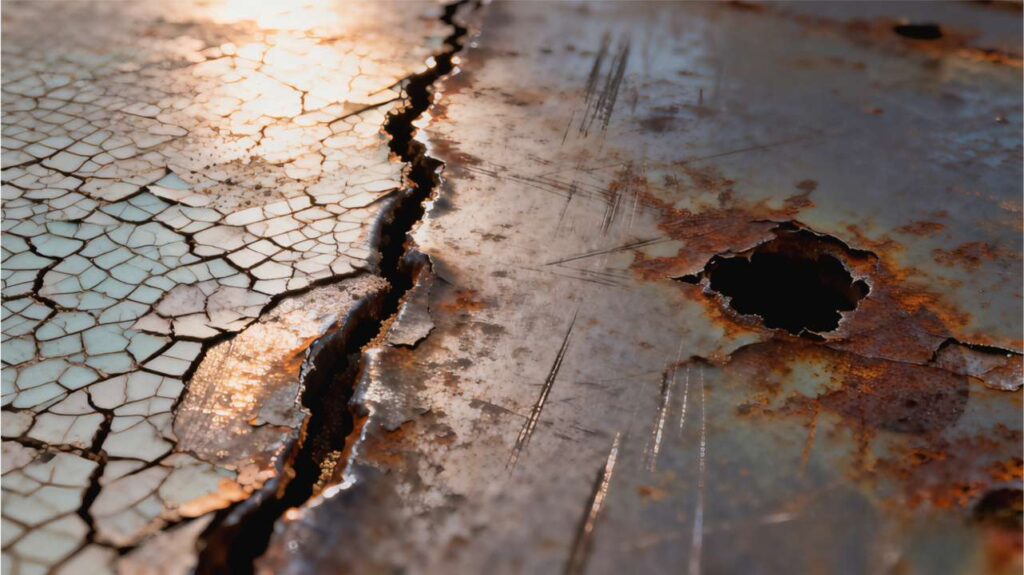
Industrial Coating Failure Analysis: Why Systems Break Down
Industrial coating failure is rarely caused by a defective product. When protective coatings for steel fail before their design life, the root cause is almost always a mismatch between surface condition, system design, or application controls — and the failure mechanism was established before the topcoat was even applied.
Two system-level errors produce the majority of premature failures on industrial steel projects:
Specifying a product instead of a system. Writing an RFQ around “epoxy coating” without defining the layer role (primer, intermediate build coat, or topcoat), the environment category, and the DFT requirement means suppliers quote non-comparable products. A primer-grade epoxy applied as an intermediate coat produces insufficient barrier DFT; an interior-grade epoxy applied to an outdoor C4 environment chalks within 12–18 months. Neither failure has anything to do with product quality — both are specification errors.
Skipping or shortcutting surface preparation. Surface preparation quality is the single variable with the highest impact on protective coating adhesion and service life. Every major coating failure investigation reports the same finding: contamination, inadequate blast grade, or incorrect surface profile was present at the primer/steel interface before application began. A premium coating system applied to under-prepared steel will fail earlier than a standard system applied correctly to Sa 2.5 blast-cleaned steel.
Most Common Protective Coating Failures on Steel
Each failure mode below has a distinct symptom, a predictable root cause, and a specific prevention action. Identifying which failure type is present is the first step toward writing a corrective specification.
Peeling and Delamination
What it looks like: coating separates from the steel substrate or from the previous coat in sheets or flakes; edges and welds are typically the first locations where peeling initiates.
Root causes:
-
Inadequate surface preparation — mill scale, rust, oil, or dust present at the primer/steel interface at the time of application
-
Surface contamination between coats — dust, moisture, or salt deposited on a cured coat before the next coat is applied
-
Application outside recommended temperature or humidity limits — the primer or intermediate coat did not achieve full adhesion to the substrate
-
Maximum recoat window exceeded — the previous coat is too fully cured for the next coat to achieve adequate chemical bond
Prevention controls:
-
Sa 2.5 blast preparation minimum for zinc-rich primer and high-build epoxy systems in C3 and above environments
-
Surface inspection and sign-off before primer application — oil/grease removal confirmed, dust level verified, surface profile within TDS range
-
Recoat window tracking per coat: record application time, temperature, and humidity, and compare to TDS minimum and maximum intervals before each subsequent coat
-
If maximum recoat window is exceeded: sweep blast or mechanical abrasion plus cleaning before next coat
Blistering
What it looks like: dome-shaped raised areas in the coating film, ranging from pinhead size to several centimetres in diameter; typically worst in coastal, high-humidity, or immersion-adjacent environments.
Root causes:
-
Soluble salt contamination on the steel surface before primer application — osmotic pressure drives moisture through the film toward the salt deposit, forming blisters as the film detaches
-
Moisture present on or in the substrate at time of application — condensation on cold steel, or residual moisture after water washing not fully dried
-
Solvent entrapment — over-thick application in a single coat traps solvent that cannot escape before the film skins over; the trapped solvent then outgasses under service conditions
-
Short recoat time — applying the next coat before the previous coat has released sufficient solvent
Prevention controls:
-
Soluble salt testing before primer application on all coastal and high-humidity sites — typical acceptance limit ≤ 20 mg/m² for C4–C5 environments; confirm against project specification
-
Confirm substrate temperature is at least 3°C above dew point before and during application — dew point measurement is a mandatory hold point on coastal sites, not an optional check
-
Apply within specified DFT per coat — do not attempt to build total system DFT in fewer coats than specified by applying over-thick individual coats
-
Minimum recoat interval compliance: allow full solvent release from each coat before applying the next
Cracking
What it looks like: map cracking, alligator cracking, or linear cracks in the coating film; most common in high-build epoxy systems and most visible at areas of film overbuild.
Root causes:
-
Excessive DFT applied in a single coat — thick epoxy films develop internal stress as they cure and shrink; above the maximum DFT specified in the TDS, this stress exceeds the film’s tensile strength
-
Rigid system selected for a substrate subject to thermal cycling or mechanical movement — the film cannot accommodate the substrate movement and cracks under stress
-
Improper cure — application in conditions outside the TDS temperature range produces a film that is under-cured and has reduced mechanical properties
Prevention controls:
-
Build total system DFT across the specified number of coats — do not compensate for a missed coat by doubling the DFT of the next coat
-
Confirm maximum DFT per coat from TDS before application begins; this limit applies as strictly as the minimum
-
For steel subject to thermal cycling (near hot equipment, exposed outdoor structures), confirm system flexibility and elongation properties against service conditions before specifying
-
Monitor and record application temperature and humidity — do not apply when ambient conditions are outside the TDS application window
Rust Bleed-Through and Underfilm Corrosion
What it looks like: rust staining visible through or around the topcoat surface, typically originating at edges, weld toes, bolt heads, and cutouts; in advanced cases, visible film lifting around the rust origin point.
Root causes:
-
Insufficient film build at edges and welds — geometric film thinning during spray application produces DFT at sharp details significantly below the flat-surface average; corrosion initiates at these thin spots first
-
Mill scale or corrosion products not removed during surface preparation — active corrosion continues under the film
-
Holidays, pinholes, or mechanical damage to the coating that allow moisture and oxygen to reach the steel surface
-
Wrong primer for the environment — standard epoxy primer without cathodic protection in a C4–C5 coastal environment cannot arrest corrosion at the coating interface
Prevention controls:
-
Mandatory brush stripe coating at all edges, weld toes, bolt heads, and connections before each full-area spray coat — this is the single most effective step for preventing rust bleed-through at high-risk details
-
DFT measurement at edge and weld details as a separate inspection hold point — not averaged with flat-surface readings
-
For C4–C5 environments: zinc-rich primer as the system foundation to provide cathodic protection at the steel interface and arrest corrosion even at minor coating defects
-
Holiday testing for immersion service and critical splash zone sections where pinhole defects pose unacceptable risk
Root Causes of Coating Failures: What to Verify Before Application
These four root cause categories account for the majority of protective coating failures on industrial steel projects. Each can be verified and controlled at the specification and inspection stage — none requires a product change to address.
1. Improper surface preparation
Poor surface preparation is the leading cause of protective coating adhesion failure and underfilm corrosion. Industrial coating blast cleaning to the correct grade — Sa 2.5 per ISO 8501-1 for high-performance anti-corrosion systems — removes mill scale, corrosion products, and contamination, and creates the surface profile required for mechanical adhesion. Preparation below Sa 2.5 reduces adhesion proportionally and eliminates the cathodic protection function of zinc-rich primer systems.
Verify: blast grade achieved and documented; surface profile within TDS range (typically 40–75 µm Rz for epoxy systems); soluble salt level within acceptance limit; oil and grease removal confirmed.
2. Wrong protective coatings epoxy systems for the environment
A coating system specified without considering the actual service environment — temperature, humidity, UV exposure, chemical contact, immersion, or abrasion — will fail early even if applied perfectly. The most common version of this error is specifying a standard industrial system for a coastal or offshore environment without zinc-rich primer, or specifying an aromatic epoxy as the outdoor topcoat in a UV-exposed location.
Verify: ISO 12944-2 corrosivity category is defined; system primer type matches the environment (zinc-rich for C4–C5 cathodic protection requirement); topcoat is UV-stable aliphatic polyurethane for all outdoor steel.
3. Environmental mismatch during application
High relative humidity, low temperature, or poor ventilation during application produces moisture entrapment, under-cure, and adhesion loss that is not visible until the system is in service. Application outside the TDS temperature and humidity window is one of the most under-inspected failure causes on site — it happens in the early morning hours on coastal sites and during shoulder seasons on outdoor projects.
Verify: temperature and relative humidity recorded at application time and compared to TDS limits; substrate temperature confirmed at least 3°C above dew point; ventilation adequate for solvent release in confined spaces.
4. Poor application control: DFT, mixing, and recoat timing
Over-thick individual coats, missed recoat windows, and incorrect mixing ratios (for two-component systems) each produce specific, predictable failure modes. Two-component epoxy systems applied with incorrect hardener ratio either under-cure (soft, sticky film with poor chemical resistance) or over-catalyse (brittle film with reduced adhesion and impact resistance). Neither condition is visible immediately after application.
Verify: mix ratio confirmed against TDS before each batch; induction time (if specified) observed; DFT measured per coat and compared to TDS minimum and maximum; recoat time and ambient conditions recorded.
How to Prevent Industrial Coating Failures: Specification and Process Controls
System selection rules (engineering first):
-
Define the environment category (ISO 12944-2) and durability target (ISO 12944-5 L/M/H) before selecting any product
-
Specify the full system — primer, intermediate coat, topcoat — with DFT per layer and total DFT, not just a product name
-
Do not omit primer or topcoat layers unless the manufacturer explicitly approves the reduced system for the specific service environment
-
For outdoor steel: always specify UV-stable aliphatic polyurethane topcoat — aromatic epoxy as the final coat on outdoor steel is a specification error, not a cost saving
Process controls that prevent rework:
-
Verify surface preparation and contamination before primer application — document as a signed hold point in the inspection record
-
Control application environment (temperature, humidity, dew point, ventilation) at each coat — do not rely on weather forecasts; measure conditions at the actual application location
-
Apply within TDS DFT per coat limits and respect both minimum and maximum recoat windows
-
Stripe coat all edges, welds, bolt heads, and connections by brush before each full-area spray pass
Fast diagnosis table:
Industrial Coating Inspection Services: QC Checklist for Surface Prep, DFT, and Recoat
This checklist covers the three inspection stages where the majority of coating failures are preventable. Each stage should be a documented hold point in the project quality plan.
Stage 1 — Surface preparation acceptance (before primer application):
-
Confirm blast grade and surface cleanliness per project specification — Sa 2.5 minimum for C3 and above industrial and marine service
-
Measure surface profile (Rz) and confirm within TDS requirement
-
Soluble salt test and acceptance — mandatory hold point on coastal and offshore sites; record result and sign off before priming
-
Confirm oil and grease removal; check dust level at application surface
-
Record ambient temperature, relative humidity, and dew point at time of preparation acceptance
Stage 2 — DFT and coat count control (during and after each coat):
-
Measure and record DFT per coat separately — do not combine into a total system reading
-
Take readings across the full structure: flat panels, edges, welds, bolt heads, cutouts, and connection details
-
Record minimum, maximum, and average DFT per coat per structural member — not just a single pass/fail reading
-
Compare to both minimum (corrosion protection) and maximum (cracking risk) DFT limits from TDS and project specification
-
Document stripe coat completion for all details before each full-area spray coat
Stage 3 — Recoat interval and application environment control (between each coat):
-
Record batch numbers, mix ratios, induction time (if applicable), and application start time for each coat
-
Record temperature and relative humidity at application time — not forecast, not laboratory standard — actual field measurement
-
Confirm elapsed time between coats is within TDS minimum and maximum recoat window before application begins
-
If maximum recoat window is exceeded: sweep blast or mechanical abrasion plus cleaning, documented before next coat
-
For two-component systems: confirm pot life has not been exceeded before completing coat application
Protective coating inspection stage sign-off:
Each of the three stages above should be signed off by the applicator supervisor and the client or third-party inspector before proceeding to the next stage. Inspection records form the primary evidence base for warranty claims and failure investigations — undocumented hold points cannot be used as evidence that the specification was met.
RFQ Checklist: How to Get a Failure-Prevention System Recommendation
Substrate and current condition:
-
Steel grade; new build or maintenance repaint
-
Current coating condition if maintenance repaint (adherent/disbonded; known system if available)
Service environment:
-
Outdoor / indoor / coastal / immersion / chemical contact / high humidity / high temperature / abrasion exposure
-
ISO 12944-2 corrosivity category if defined by project specification or client standard
Execution constraints:
-
Surface preparation method available: abrasive blast / power-tool / spot blast
-
Application method: shop coating / site application
-
Temperature and humidity range at application site and season
-
Shutdown schedule and application window constraints
Performance requirements:
-
Required service life / maintenance interval target
-
ISO 12944-5 durability class (L / M / H) if specified
-
Any specific failure mode being addressed from the list above (delamination / blistering / cracking / rust bleed)
Documents required from supplier:
-
TDS + SDS per product
-
Full system recommendation: primer + intermediate + topcoat, with DFT and recoat windows per layer
-
Application method statement
-
Inspection checklist aligned to the three hold-point stages above
FAQ
What is the most common cause of industrial coating failure on structural steel?
Inadequate surface preparation is consistently identified as the leading cause of protective coating failure on structural steel. Poor blast grade, residual contamination, or insufficient surface profile at the primer/steel interface reduces adhesion, eliminates cathodic protection function in zinc-rich primer systems, and creates the conditions for underfilm corrosion to initiate before the coating system reaches its design life. The failure typically does not become visible until rust bleed-through or delamination appears at the surface — at which point corrosion has already progressed significantly at the interface. Sa 2.5 blast preparation per ISO 8501-1, combined with soluble salt verification before primer application, is the most effective single step for preventing premature failure.
Why does coating blister in coastal environments even when it looks well-applied?
Blistering in coastal environments is typically caused by soluble salt contamination on the steel surface at the time of primer application — not by a product defect. Dissolved chloride salts attract moisture osmotically through the coating film, building pressure under the film that detaches it from the substrate as blisters. The contamination may not be visible to the eye and is not removed by dry blasting — it requires wet washing, salt testing (Bresle patch or equivalent), and acceptance against a soluble salt limit before priming. The typical acceptance limit for C4–C5 coastal service is ≤ 20 mg/m²; this must be confirmed against the project specification and TDS.
How do I prevent rust bleed-through at edges and welds in a protective coating system?
Rust bleed-through at edges and welds is caused by geometric film thinning — spray application pulls back from sharp surfaces under surface tension, leaving DFT at edges significantly below the flat-surface average. The prevention is mandatory brush stripe coating: apply each coat by brush at all edges, weld toes, bolt heads, and connection details before the full-area spray coat. This ensures adequate film build at the exact locations where corrosion risk is highest. Stripe coating should be written as a mandatory hold point in the specification — not left to contractor discretion — and DFT at edge details should be measured and recorded separately at each inspection stage.
What is the correct DFT application approach for high-build epoxy systems?
High-build epoxy systems must be applied within the DFT per coat limits specified in the TDS — both minimum and maximum apply. Attempting to reach total system DFT in fewer coats by over-applying individual coats is the primary cause of cracking in high-build epoxy systems: thick epoxy films develop internal stress during curing and shrinkage, and above the maximum DFT per coat, this stress exceeds the film’s tensile strength and produces map cracking or edge cracking. The correct approach is to apply the number of coats specified, at the DFT per coat specified, and verify each coat with a DFT gauge before applying the next.
When should I specify zinc-rich primer instead of standard epoxy primer on structural steel?
Zinc-rich primer should be specified on structural steel in C4–C5 corrosivity environments (coastal, industrial, marine atmospheric) and on any steel where cathodic protection is required at the coating interface — including CP-protected structures, offshore and splash zone steel, and long-service-life projects where underfilm corrosion at coating defects must be arrested. Standard epoxy primer provides adhesion and barrier protection but does not offer cathodic protection — at any holiday, scratch, or damage point in the film, corrosion initiates and spreads laterally under the coating without the sacrificial zinc mechanism to arrest it. Sa 2.5 blast preparation is required for zinc-rich primer to establish the zinc-to-steel electrical contact that enables cathodic protection.