Introduction
In industrial projects, corrosion protection decisions are often made too late—or based on assumptions rather than operating reality.
Many project teams specify heavy duty anti-corrosion coatings believing they are “safer” or “more durable” by default. In practice, this approach frequently leads to over-engineering, budget waste, or application failure.
From our experience working with steel structures, industrial equipment, and long-life assets, coating failures rarely come from product defects. They come from misjudging exposure conditions, service life expectations, and construction constraints.
What Heavy Duty Anti-Corrosion Coatings Really Mean
Heavy duty anti-corrosion coatings are not a single material category and not defined only by thickness or price.
In engineering practice, they refer to coating systems designed for high-risk corrosion environments, where standard industrial coatings cannot reliably meet the required service life.
Key characteristics typically include:
Multi-layer coating systems rather than single coats
Designed for long-term exposure (often 10–25 years)
High dependency on surface preparation quality
Applied in environments with aggressive corrosion drivers
The critical point is this:
“Heavy duty” describes the application scenario, not just the coating itself.
A coating system that performs well in a controlled factory environment may fail quickly when exposed to marine air, chemical vapors, or cyclic wet–dry conditions.
Why Heavy Duty Anti-Corrosion Matters in Real Projects
In real-world projects, corrosion protection is not just a technical issue—it is a project risk issue.
From an engineering and asset-management perspective, heavy duty coating decisions directly affect:
Structural service life
Inadequate systems lead to early steel degradation and reduced load safety.Maintenance access and cost
Offshore or elevated structures make recoating extremely expensive.Operational continuity
Coating failure often triggers unplanned shutdowns or restricted operation.Total lifecycle cost (LCC)
A lower initial coating cost frequently results in higher long-term expenses.
This is why heavy duty anti-corrosion coatings are commonly specified not for performance alone, but to control uncertainty over decades of operation.
Key Factors Engineers Must Consider
Exposure Environment and Corrosion Category
The most common mistake is underestimating environmental severity.
Key exposure factors include:
Marine atmosphere or offshore splash zones
Chemical fumes, spills, or immersion
High humidity with frequent condensation
UV radiation combined with temperature cycling
If corrosion severity is underestimated, even a so-called heavy duty system may fail far earlier than expected.
Surface Preparation Capability
Heavy duty coatings do not forgive poor surface preparation.
In most cases, performance depends more on preparation quality than coating brand.
Typical requirements include:
Abrasive blasting to Sa 2.5 or equivalent
Controlled surface profile
Clean, dry substrate before application
If the project site cannot consistently meet these conditions, specifying a high-performance system may actually increase failure risk.
Required Design Life vs. Project Reality
Not every project requires maximum durability.
Engineers should clearly define:
Intended service life of the structure
Accessibility for future maintenance
Acceptable inspection and repair intervals
Applying a 25-year system to a temporary or easily accessible structure often offers no real return on investment.
Application and Curing Conditions
Many heavy duty coatings require strict control over:
Ambient temperature
Humidity and dew point
Curing time between coats
If site conditions are unstable or poorly managed, system performance will not match laboratory expectations.
Common Mistakes and Failure Scenarios
Based on field experience, common failures include:
Selecting heavy duty systems purely based on specification habit
Overemphasizing dry film thickness instead of system compatibility
Ignoring maintenance planning during design stage
Applying advanced coatings on inadequately prepared steel
Assuming one heavy duty system fits all environments
In many cases, a simpler, well-matched system outperforms an over-specified one.
Recommended Coating System Approaches
Rather than focusing on product names, engineers should think in system logic.
Common heavy duty anti-corrosion approaches include:
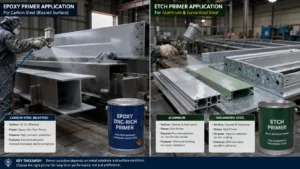
Zinc-rich primer + epoxy intermediate + polyurethane topcoat
High-build epoxy systems for severe industrial exposure
Specialized epoxy systems for chemical or immersion conditions
System selection should always be based on:
Environment classification
Surface preparation capability
Required service life
Maintenance strategy
At this stage, technical consultation often adds more value than comparing datasheets.
Standards, Notes, and Practical Engineering Tips
International references often used in heavy duty corrosion protection include:
ISO 12944 for steel structure corrosion protection
SSPC surface preparation standards
Project- or owner-specific specifications
Practical tips from project execution:
Match coating system to real site conditions, not ideal assumptions
Define inspection checkpoints before coating application begins
Avoid mixing systems from different suppliers without validation
Standards provide the framework—but engineering judgment determines success.
Contact Us
We would love to speak with you.
Feel free to reach out using the below details.