Maintenance schedules for fireproof coatings are not optional — fireproof coatings are tested and rated assuming intact condition, and any damage from mechanical impact, chemical exposure, or weathering directly reduces the protection time the system can deliver during a fire event. A coating that appears visually acceptable may have lost a significant portion of its rated performance if delamination, moisture ingress, or corrosion has developed beneath the film surface.
This guide provides practical inspection checklists, damage classification criteria, repair procedures, and documentation requirements to help asset owners and maintenance engineers manage fireproofing as a long-term engineered system rather than a one-time application scope.
Quick Reference:
- Schedule routine visual inspections every 12 months for industrial fireproof coatings — more frequently in high-impact or high-chemical-exposure areas
- Check for cracks, blisters, rust bleed, contamination, and mechanical damage at each inspection
- Repair minor localised damage promptly by cutting back to sound substrate and matching the original system layers
- Document all inspections and repairs with photos, location references, and material records for compliance and insurance purposes
- Combine fireproof coating checks with corrosion inspection campaigns to minimise shutdown frequency in operating plants
For the full range of fire protection coating systems referenced in this guide, see the fire protection coatings product range.
Why Maintenance Matters for Fireproof Coatings
Fireproof coatings — whether intumescent painting systems, epoxy intumescent, or cementitious fireproofing — are passive fire protection systems that perform a single critical function: delivering rated structural protection time during a fire incident. That function depends entirely on the coating being in intact, designed condition at the moment it is needed.
In industrial environments, the degradation drivers are continuous: forklifts and mobile equipment generate mechanical impact on column bases and lower steel; pipe leaks and chemical cleaning introduce contamination and moisture beneath the film; UV exposure and temperature cycling cause surface chalking and micro-cracking; and equipment modifications create unprotected areas where drilling, cutting, or welding has removed the original coating. Most fireproofing failures result from gradual accumulated neglect rather than a single event — the consequence is a costly full recoat instead of a simple spot repair that could have been completed in hours.
Proactive maintenance schedules for fireproof coatings preserve both the technical performance of the system and compliance with building regulations, insurance requirements, and asset integrity management frameworks.
Maintenance Schedules for Fireproof Coatings: Industrial Frequency Guide
Inspection frequency is driven by the exposure environment and the consequence of undetected damage — higher-risk zones require shorter intervals and more structured documentation:
Ordinary indoor environments (office buildings, machine rooms, enclosed steel):
Full inspection within 12 months of completion to identify construction defects and installation damage, then every 3–5 years in stable, low-exposure conditions. These environments have minimal mechanical, chemical, or UV degradation drivers.
Industrial and warehouse environments (medium mechanical and chemical stress):
Annual routine inspections targeting walkways, loading areas, vehicle routes, and zones with regular condensation or humidity cycling. Annual frequency is the minimum standard for any environment classified as industrial service.
Harsh industrial, coastal, or outdoor environments (heavy corrosion or impact exposure):
Comprehensive annual inspections plus additional checks after major maintenance events, equipment changes, structural modifications, or significant weather events. In areas with frequent forklift impact or chemical splash, shorten intervals and combine with corrosion survey campaigns to reduce total shutdown time.
Scheduling principle: align fireproof coating inspections with planned corrosion inspection outages to minimise plant disruption. Combining both scopes in a single shutdown window reduces total access cost and limits production impact.
What to Look for During Fireproof Coating Inspections
Routine visual inspection does not require specialised instruments — it requires systematic coverage of all fire-critical members with a defined checklist and documented findings. Focus on the following indicators of reduced protection performance:
- Mechanical damage: scratches, dents, chips, and gouges from impact — particularly at column bases, beam lower flanges, and areas within forklift operating radius
- Cracks and blisters: surface cracking, bubbling, or visible delamination indicating loss of adhesion between the fireproofing coating and substrate or primer
- Corrosion signs: rust bleed breaking through the coating surface on steel members, concrete spalling, or rebar exposure on concrete-encased structures
- Discolouration and chalking: surface fading, powdering, or loss of film integrity from UV degradation or thermal cycling — indicates advanced aging even where the film appears otherwise intact
- Contamination and moisture: oil stains, chemical residues, or chronic dampness at the base of columns and in low-drainage areas — these are often indicators of sub-film moisture that will accelerate adhesion failure
- Edges and interface details: gaps or lifting at bolts, weld toes, corners, wall penetrations, and pipe-to-structure interfaces — these are the highest-risk locations for moisture ingress and corrosion initiation
Always cross-reference inspection findings with the original fire protection drawings to prioritise fire-critical primary members — beams and columns carrying load under fire conditions — over secondary steelwork.
Maintenance Checklist for Fireproof Coatings
Use this checklist during inspections — adapt for digital or paper records as required by your asset management system:
| Check Item | Content | Record Format |
|---|---|---|
| Area identification | Area number, floor level, member ID, grid reference | Text + drawing reference |
| Surface integrity | Cracks, delamination, blisters, chips — extent and location | Grade + photo |
| Corrosion condition | Rust bleed through coating, spalling, rebar exposure | Grade + photo |
| Contamination / moisture | Oil, chemical residues, water pooling or staining | Description + photo |
| Mechanical damage risk | High-impact path (forklift routes, loading areas) | Yes / No + dimension |
| Recent modifications | Drilling, welding, cutting, equipment attachment | Details + date |
| Repair history | Last recoat date, materials used, contractor | Record reference |
| DFT spot check | Gauge reading where damage is suspected | Reading + location |
| Recommended action | Monitor / repair within 3–6 months / urgent repair | Classification |
For intumescent fire protection coatings near high-temperature equipment, add specific checks for heat blistering, soot buildup, and thermal shock cracking at the heat-affected zone boundaries.
When Is Repair or Recoating Required?
Classify damage at inspection to determine urgency and repair scope — this classification prevents both under-response (ignoring progressive damage) and over-response (full recoat when spot repair is sufficient):
Minor cosmetic issues (surface chalking, slight discolouration, no substrate exposure):
Monitor at next scheduled inspection interval. Schedule recoat during the next planned major shutdown. No immediate structural fire protection compromise if the film is intact.
Localised damage (small chips, cracks, or exposed substrate on non-critical members):
Repair within 3–6 months. Priority increases if the damaged area is on a primary fire-critical member (main beam or column) or in a high-moisture environment where corrosion initiation is likely.
Major failure (large delamination, extensive steel exposure, heavy corrosion under film, or multiple adjacent damage zones):
Plan a comprehensive repair scope including substrate treatment and full system rebuild in the affected area. Do not delay — corrosion under delaminated fireproofing accelerates rapidly once moisture access is established.
Manufacturer assessment is recommended for any repair scope that may affect the rated fire protection performance — repairs that do not match the original tested system configuration may invalidate the fire rating for the repaired zone.
Basic Repair Procedures for Fireproof Coatings
These general repair steps apply to most intumescent coatings application for steel structures scenarios — always confirm compatibility with the original system TDS before proceeding:
- Define the repair boundary: mark the repair area generously, cutting back beyond the visible damage edge to sound, well-adhered coating — minimum 50 mm into intact coating at all boundaries
- Remove all loose and damaged material: use hand tools, needle gun, or low-impact power tools to remove loose fireproofing coating to sound substrate — avoid impact tools that could damage sound adjacent coating
- Prepare the exposed substrate: clean all corrosion, contaminants, and soluble salts from any exposed steel — achieve a surface profile suitable for primer application per the original system specification
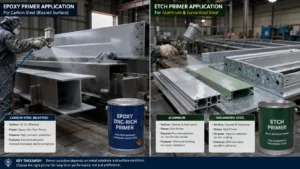
- Apply compatible primer: apply the primer specified in the original system TDS to any exposed bare steel — do not skip this step, even for small repair areas, as primer is the adhesion and corrosion control foundation of the system
- Apply fireproof layer in compatible lifts: build back to the original DFT in multiple lifts as specified in the TDS — single-coat application to full DFT is not acceptable for most intumescent systems and will cause cracking and adhesion failure
- Feather and blend edges: feather the repair edge into the surrounding intact coating for a smooth transition — abrupt edges create stress concentration points and visible boundaries for future inspection
- Apply topcoat if specified: if the original system included a topcoat or sealer, apply the same compatible product over the repair area
- Document the repair: record materials used, batch numbers, application date, ambient conditions, DFT readings, and inspector name — attach to the asset inspection record
Documentation and Record-Keeping
A centralised maintenance record is both a compliance requirement and a practical asset management tool — it enables trend analysis, supports insurance claims, and provides the baseline data needed for future repair scopes:
Original installation records: system specification, product TDS, as-built DFT records by zone, installer certification, and fire rating documentation
Each inspection record: date, inspector name and qualification, findings by member reference, photographs with location annotations, damage classification, and recommended action with target completion date
Each repair record: repair area and member reference, materials used with batch numbers, application method, ambient conditions during application, post-repair DFT readings, and inspector sign-off
These records support regulatory audits, property insurance compliance, and asset sale or transfer documentation — gaps in the record trail consistently create disputes and delays at these events.
Special Considerations for Industrial Fireproofing Coatings
Industrial fireproofing coatings in process plant environments face degradation drivers that do not exist in commercial or structural building applications — these require additional inspection focus beyond the standard visual checklist:
Equipment zones, pipe racks, and tank supports: chemical exposure from process leaks and cleaning operations, and mechanical impact from maintenance activities, make these zones the highest-risk areas for fireproofing degradation. Increase inspection frequency and document the specific chemical exposure profile to select compatible repair materials.
High-temperature areas near furnaces, stacks, and process heaters: monitor specifically for thermal shock cracking at the boundaries of heat-affected zones, soot and oil contamination buildup that masks underlying damage, and blistering from cyclic heat exposure that exceeds the coating’s temperature rating.
Vibration-sensitive areas: structural steel adjacent to rotating equipment, pump bases, and compressor skids experiences continuous cyclic loading that accelerates micro-cracking and adhesion fatigue in fireproofing films — inspect these zones at shorter intervals than the general site schedule.
For fire protection coating for steel in high-temperature or chemical exposure service, confirm the coating’s temperature and chemical resistance ratings from the TDS before specifying repair materials — using a lower-rated system for repairs in a high-temperature zone invalidates the repaired zone’s fire rating. See high-temperature industrial coatings for compatible system options.
FAQ
How often should fireproof coatings be inspected in industrial plants?
Annual inspections are the minimum standard for industrial environments — any environment with mechanical impact risk, chemical exposure, or outdoor weathering should not extend beyond 12-month inspection intervals. High-risk zones such as vehicle routes, loading areas, and chemical splash zones should be inspected every 6 months or incorporated into routine corrosion survey campaigns. The inspection interval should be formally defined in the asset’s integrity management plan, not left to informal scheduling.
What are the signs that a fireproof coating needs repair?
The primary repair triggers are: visible cracks or delamination of any extent on primary fire-critical members; rust bleed or surface corrosion at any location (minor rust bleed indicates sub-film moisture which will worsen without intervention); mechanical damage exposing the substrate or primer; and contamination from oil or chemicals that has penetrated the film. Surface chalking and minor discolouration can be monitored without immediate repair if the film is otherwise intact, but should be scheduled for recoat at the next planned shutdown.
Can minor surface rust be ignored if the coating is still mostly intact?
No — minor rust bleed through a fireproofing coating surface is a diagnostic indicator of moisture ingress and active sub-film corrosion, not a cosmetic issue. Once moisture has penetrated beneath the coating film, corrosion progresses continuously and will undercut the coating bond, leading to delamination that propagates well beyond the original visible rust bleed area. Assess and repair rust bleed within the next planned maintenance window — do not defer to the next scheduled inspection cycle.
Is it necessary to use the same product brand for fireproof coating repairs?
Compatible system chemistry is the technical requirement — not necessarily the same brand. The repair system must match the original coating’s chemistry type (epoxy intumescent, water-based intumescent, or cementitious), DFT specification, and primer compatibility. Consult the original TDS for approved repair systems and compatible alternatives. Using an incompatible system — for example, a water-based intumescent over an epoxy intumescent primer — can produce adhesion failure at the repair boundary and may invalidate the fire rating for the repaired zone.
Who should perform fireproof coating inspections — in-house team or external specialists?
Routine visual inspections using the checklist format in this guide can be performed by a trained in-house maintenance team familiar with the asset — the key requirement is systematic coverage with documented findings, not specialist certification. Damage assessment for repair scope definition, DFT verification after repairs, and any inspection that will be used to support insurance compliance or regulatory audit should be performed by qualified coating inspectors with fireproofing-specific experience. External specialists are also recommended for post-incident inspections where heat exposure may have altered coating performance in ways not visible to routine observation.
Maintenance schedules for fireproof coatings depend on the specific environment, service conditions, and system type. Always verify inspection intervals, repair methods, and compatible materials against the original product TDS and project specification before work begins.
If your fireproof coatings show damage or are due for scheduled inspection, submit photos, member location details, last maintenance date, and environment information through our industrial fireproofing inquiry form — our technical team will provide repair options, compatible material recommendations, and a customised inspection checklist for your facility.