Steel structures are used across construction, infrastructure, energy, and manufacturing, but exposure to moisture, chemicals, and harsh environments can rapidly increase corrosion risk.
That is why epoxy coating for steel is widely specified in industrial protection systems where adhesion, barrier performance, and chemical resistance matter.
Epoxy systems are rarely chosen as isolated products in serious industrial work.
In most long-life specifications, epoxy functions as a primer, an intermediate coat, or a core barrier layer inside a broader anti-corrosion system.
Quick Guide
- Use epoxy when strong adhesion and barrier protection are the main priorities.
- Add a UV-resistant topcoat when the steel will be exposed outdoors.
- Consider zinc-rich epoxy primers for harsher atmospheric or marine exposure.
- Control surface preparation, DFT, and recoat timing before expecting long service life.
- Send environment, steel condition, and coating objective before requesting TDS or pricing.
What Is Epoxy Coating for Steel
Epoxy coating for steel is a protective coating based on epoxy resin chemistry, commonly supplied as a two-component system that cures into a durable film.
Its main value is that it bonds well to steel and creates a dense coating layer with good corrosion and chemical resistance.
In industrial practice, epoxy coating steel systems are often used as primers or intermediate coats rather than as the only layer in the system.
That is why epoxy is usually discussed together with zinc-rich primers, polyurethane topcoats, or other companion layers.
Why It Is Important for Industrial Steel Protection
Steel corrosion is driven by electrochemical reactions involving moisture, oxygen, salts, and other aggressive contaminants.
In marine, industrial, buried, or high-humidity conditions, the corrosion rate can rise quickly if the steel is not isolated from the environment.
Epoxy helps because it delivers three core protection functions:
- Barrier protection through a dense film that slows water and oxygen ingress.
- Chemical resistance for many industrial service conditions.
- Strong adhesion that supports longer system stability on prepared steel.
For project owners, that combination makes epoxy a practical foundation layer in many steel corrosion-protection systems.
Compare Types of Epoxy Coating Systems for Steel
Different epoxy systems are designed for different coating roles, so selection should start with service condition rather than product name alone.
Standard epoxy coatings
Standard epoxy coatings are widely used where the goal is general industrial corrosion protection on structural steel, equipment, and fabricated components.
They are often chosen when good adhesion and barrier build are needed without moving straight to specialty linings.
High-build epoxy coatings
High-build epoxy coatings are designed to deliver thicker protective films with fewer passes, which helps improve barrier protection in heavy-duty environments.
They are commonly considered for harsher industrial exposure, tank surfaces, and applications where higher film build is part of the protection strategy.
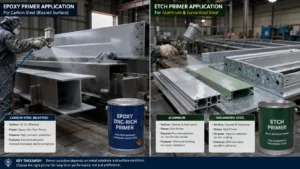
Epoxy zinc-rich primers
Epoxy zinc-rich primers combine epoxy binder performance with sacrificial zinc action, making them important in multi-layer anti-corrosion systems for steel.
They are often used on bridges, offshore steel, coastal assets, and other structures exposed to more severe atmospheric corrosion.
Solvent-free epoxy coatings
Solvent-free epoxy coatings are used where high-build anti-corrosion protection is needed with very low or zero solvent content.
They are commonly associated with tank surfaces, internal linings, and applications where lining integrity and chemical resistance are priorities.
Specialty epoxy systems
Some epoxy systems are modified for marine service, antistatic duty, tank lining, or heavy chemical environments rather than general atmospheric exposure.
That is why epoxy selection should always start with the actual service environment and not with a generic “epoxy paint” label.
Choose Key Materials Around Epoxy Systems
Epoxy is the core barrier material in many steel protection systems, but it often works best when combined with other coating families.
| Material role | What it contributes | Where it fits |
|---|---|---|
| Zinc-rich primer | Sacrificial protection and substrate-level corrosion control. | First layer on harsher steel systems. |
| Epoxy intermediate or build coat | Adhesion, barrier thickness, chemical resistance, and mechanical strength. | Core anti-corrosion layer. |
| Polyurethane topcoat | UV resistance, color retention, and exterior weather durability. | Outdoor finish coat. |
| Fluorocarbon topcoat | Higher-end weather resistance and long-term appearance stability. | Premium exterior topcoat. |
In practice, this is why many outdoor steel systems use zinc-rich primer plus epoxy build plus polyurethane or fluorocarbon finish rather than epoxy alone.
For a broader product overview, see HUILI’s epoxy anti-corrosion coating series.
Design Epoxy-Based Coating Systems for Steel
A standard epoxy-based industrial system often includes a zinc-rich primer, an epoxy intermediate coat, and a polyurethane or fluorocarbon topcoat.
This layout helps combine adhesion, sacrificial protection, barrier build, and weather resistance in one system.
Coating thickness also matters because total dry film thickness is part of how the system resists moisture and corrosive exposure over time.
Higher-corrosion environments usually need heavier-duty system build, but extra thickness cannot compensate for weak surface preparation or poor application control.
Surface preparation requirements
Proper surface preparation is one of the biggest performance drivers for epoxy systems on steel.
If the substrate is contaminated, oily, poorly profiled, or inadequately cleaned, even a good epoxy system can lose adhesion or fail early.
Typical preparation steps include:
- Abrasive blasting for high-performance systems.
- Degreasing and contamination removal before coating.
- Matching the preparation standard to the coating duty level.
Sa 2.5 and SSPC-SP10 / NACE No. 2 are widely referenced preparation levels for heavy-duty steel coating work.
Review Industrial Applications of Epoxy Coating for Steel
Epoxy coating for steel is used across a broad set of industrial assets because it adapts well to both atmospheric and lining-style service.
Structural steel
Epoxy is widely used on industrial buildings, bridges, and general steel frameworks where corrosion protection is needed as part of a multi-coat system.
Storage tanks
Epoxy-based systems are common on tanks and vessels because they provide strong barrier protection and good resistance for many industrial services.
Internal and external tank service should still be specified separately because immersion and atmospheric conditions are not the same.
Pipelines
Epoxy coatings are used in pipeline protection where corrosion resistance and chemical durability are important.
The exact system depends on whether the exposure is external, buried, or tied to a specific transported medium.
Offshore and marine structures
Marine and offshore steel often rely on epoxy-based systems because salt spray, humidity, and splash-zone exposure demand stronger barrier performance.
In these environments, epoxy is often paired with zinc-rich primers and more weather-resistant finishes.
Industrial equipment
Machinery, fabricated parts, and industrial steel components also use epoxy where corrosion resistance, mechanical durability, and maintainability must be balanced.
Understand the Advantages of Modern Epoxy Systems
Epoxy-based systems remain popular because they combine strong adhesion to steel, good chemical resistance, and compatibility with multi-layer industrial coating design.
They also give specifiers a flexible base for building different systems around the same core barrier chemistry.
Key advantages include:
- Strong adhesion to prepared steel substrates.
- Good barrier protection in many industrial and infrastructure environments.
- Compatibility with zinc-rich primers and weather-resistant topcoats.
- Suitability for both atmospheric steelwork and many tank or lining applications.
The main limitation is UV resistance.
For exterior use, epoxy usually performs better when protected by a polyurethane or similar UV-resistant finish coat.
Choose the Right Epoxy System for Your Project
Selection should start with environment, substrate condition, service objective, and application method.
That means marine exposure, tank lining, structural steel, and buried service should not all be specified with the same epoxy logic.
Use these decision rules:
- Choose zinc-rich epoxy primer when atmospheric corrosion risk is high and sacrificial protection is needed.
- Choose high-build or lining-style epoxy when higher barrier build or chemical-duty service is part of the requirement.
- Add polyurethane when outdoor UV and weathering matter.
- Review preparation capability before selecting a heavy-duty epoxy system.
If you are comparing finish-layer roles, HUILI’s epoxy vs polyurethane coating guide helps clarify where each material belongs in the system.
Control Common Mistakes and Inspection Points
Many epoxy coating failures are linked to preparation, application, or specification gaps rather than to epoxy chemistry itself.
The most common problems are poor cleaning, low profile control, missed edges, incorrect recoat timing, and using epoxy outdoors without the right finish layer.
Check these points before approving the job:
- Surface is clean, dry, and prepared to the required standard.
- DFT is measured across flats, welds, edges, and repaired areas.
- Recoat windows are controlled between primer, epoxy build coat, and topcoat.
- Tank or lining service uses the correct epoxy type rather than a generic atmospheric epoxy.
- Outdoor epoxy systems include a compatible UV-resistant topcoat where required.
What buyers often forget:
- Epoxy alone is not always the complete system for exterior steel.
- Surface preparation capability on site may be lower than what the specification assumes.
- Repair areas, welds, and sharp edges need closer inspection than easy flat panels.
Conclusion
Epoxy coating for steel remains one of the most reliable and widely used solutions for industrial corrosion protection because it combines adhesion, barrier performance, and chemical resistance in a highly adaptable system chemistry.
Its best performance comes when epoxy is integrated into a properly designed coating system with the right primer, topcoat, preparation standard, and inspection control.
FAQ
What is epoxy coating for steel?
Epoxy coating for steel is a resin-based protective coating system that cures into a durable film with strong adhesion and good corrosion resistance.
Where are epoxy coatings commonly used?
They are widely used on structural steel, storage tanks, pipelines, offshore structures, and industrial equipment.
Why are epoxy coatings used as primers?
Epoxy primers bond well to steel and serve as the foundation layer in many anti-corrosion coating systems.
Can epoxy coatings be used outdoors?
Yes, but outdoor epoxy systems usually perform better with a UV-resistant topcoat such as polyurethane because epoxy has weaker UV resistance on its own.
What is epoxy coating for steel reinforcement?
In construction use, this term usually refers to epoxy protection applied to reinforcing steel used inside concrete to reduce corrosion risk.
The specification route for reinforcement differs from exposed structural steel systems.
How long does an epoxy coating system last?
Service life depends on system design, environment, preparation quality, and maintenance strategy rather than on epoxy alone.
In practice, durability planning is usually tied to exposure category and time to first major maintenance.
Technical Note
Epoxy system selection, coating thickness, and preparation level should be verified against the latest TDS, actual exposure conditions, and approved project specification before procurement or application.
Where environment-based design logic is required, align the system with corrosivity category, preparation standard, and maintenance target before final approval.
Request a System Recommendation
Send your project environment, steel type, asset type, surface preparation condition, drawings, and target durability through our contact page so our technical team can recommend a suitable epoxy coating for steel, provide TDS, and help you prepare a clearer RFQ.