Middle East industrial projects do not have one corrosion environment — they have several, often on the same asset. High temperature coatings are required near stacks, hot piping, and process equipment; UV-stable polyurethane systems are required on outdoor structural steel exposed to direct solar radiation; zinc-epoxy systems are required in coastal salt zones; and sheltered indoor steel may need only a standard barrier system. Specifying “generic industrial coating” across a Middle East facility produces a system that is over-engineered in low-risk areas and critically under-engineered in the zones that actually drive early failure.
This guide covers why corrosion is particularly aggressive in Middle East environments, how to match the correct high temperature coating materials and system family to each zone, and what to include in an RFQ to receive a technically comparable proposal.
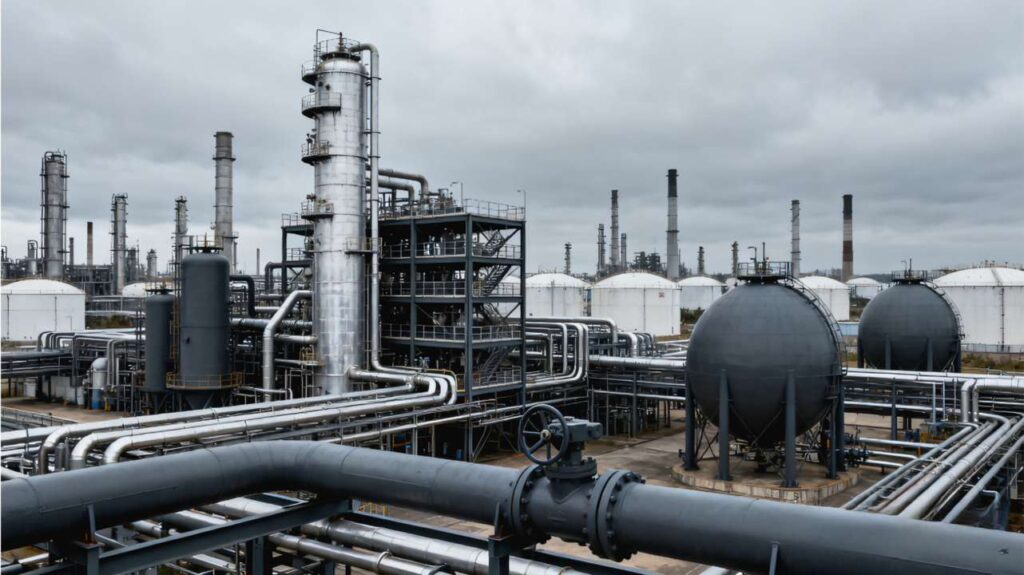
Why Corrosion Is Severe in Middle East Industrial Projects
Middle East industrial environments combine multiple corrosion drivers simultaneously — a condition that standard atmospheric corrosion models underestimate if the site is assessed as a single environment rather than as a set of overlapping zones.
Coastal and offshore areas in the Gulf region experience high relative humidity, elevated chloride deposition rates, and temperatures that accelerate electrochemical corrosion reactions at the steel surface. ISO 12944-2 classifies these conditions as C4 (high corrosivity) to C5-M or CX (offshore/extreme), and the standard explicitly links these categories to higher DFT requirements and more robust system selection for long durability targets.
Desert wind-driven sand introduces a failure mode that does not appear in temperate industrial environments: mechanical abrasion of the coating film from particulate impact. A topcoat that performs adequately in a European industrial environment can be mechanically worn through within two to three years in a desert site with regular sand events — exposing the intermediate coat and eventually initiating corrosion at edges and weld details where DFT is already at its minimum.
A critical specification error on Middle East projects is treating “hot and humid” as a single exposure category. In practice, a GCC industrial facility may include shaded condensation zones (where moisture trapping drives corrosion at low temperatures), splash and spray areas around cooling systems and seawater intake structures, high-UV exposed outdoor structural steel, and hot equipment zones where surface temperatures exceed 120°C — all within the same plant boundary, requiring different industrial coating systems for each zone.
High Temperature Coating Materials: Key Requirements for Middle East Exposure
Correctly specifying an anti-corrosion coating system for Middle East service requires four performance requirements to be defined and matched to the actual zone exposure before any product is selected.
Thermal Stability for Hot Zones
Near process equipment, stacks, and hot piping, standard organic epoxy systems soften, blister, and lose adhesion as service temperatures rise above 120–150°C. High temperature anti corrosion coating for these zones typically uses silicone binder chemistry, which maintains film integrity and corrosion protection through repeated thermal cycling at elevated temperatures. The critical specification discipline is to select high-temperature systems only where temperature is the primary design driver — applying a silicone high temperature coating to ambient-temperature structural steel is unnecessary, adds cost, and may compromise application workability in wide-area spray operations.
UV and Weathering Resistance for Outdoor Steel
In Middle East outdoor environments, solar radiation intensity and UV exposure duration significantly exceed temperate industrial norms. Standard aromatic epoxy resins chalk and lose film integrity under sustained UV exposure — typically within 12–18 months in direct Gulf sun — leaving the intermediate coat exposed and progressively reducing barrier performance. UV-stable aliphatic polyurethane topcoat is the standard solution for outdoor structural steel across all Middle East corrosivity categories: it retains gloss, color, and film integrity under prolonged solar radiation and prevents the chalking failure mode that makes epoxy-only systems unsuitable as final exterior coats.
Salt and Humidity Resistance for Coastal Zones
ISO 12944 demonstrates that increasing corrosivity category — from C3 inland industrial to C4 coastal to C5-M marine — drives higher nominal DFT and more robust system selection for equivalent durability targets. For coastal Middle East steel in C4–C5-M environments, this translates directly into zinc-rich primer as the required foundation (for cathodic protection at the steel interface), higher total film build in the intermediate coat range, and confirmation of soluble salt limits on the surface before primer application. Salt contamination present on the steel surface at the time of primer application is one of the highest-probability causes of early blistering and underfilm corrosion in coastal GCC projects.
Abrasion Resistance for Desert Sand Exposure
Wind-driven sand imposes mechanical abrasion loading on coating films that is absent from standard ISO 12944 corrosivity category definitions. In high sand-event locations, topcoat selection must consider film hardness and abrasion resistance alongside UV stability — and maintenance planning must account for accelerated film consumption at exposed steel surfaces and connection details. Systems with robust polyurethane topcoats and accessible stripe coat details are significantly easier to maintain in desert environments than systems specified only for chemical barrier performance.
Recommended Industrial Coating Systems for Middle East Climate
The three system families below cover the majority of Middle East anti-corrosion coating requirements. Final product selection, DFT per coat, and total system build must be confirmed against TDS and project specification.
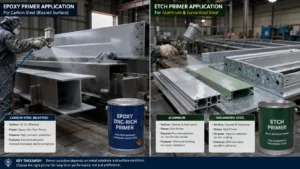
System 1: Zinc Epoxy Primer + High-Build Epoxy + Polyurethane Topcoat
Best for: outdoor structural steel, pipe racks, industrial buildings, platforms, and coastal steel not in constant immersion service — the standard system for C3–C5 atmospheric steel in Middle East projects.
Why it works: the zinc epoxy primer provides sacrificial cathodic protection at the steel interface; the epoxy polyurethane coating architecture builds sufficient barrier DFT for C4–C5 service; the aliphatic polyurethane topcoat delivers UV stability, weathering resistance, and color retention for long outdoor exposure in high-solar-radiation environments.
ISO 12944 service life alignment: Medium to High durability (7–15+ years) in C4–C5 environments depending on total DFT and surface preparation quality.
Key application requirement: Sa 2.5 blast preparation minimum; stripe coat all edges, weld toes, and bolted connections before full-area spray.
High Build Epoxy Primer System: Severe Coastal and High-DFT Applications
Best for: aggressive marine and coastal zones in C5-M and CX categories, areas requiring fewer total coats, and maintenance repainting where access is limited and application time is constrained.
Why it works: high build epoxy primer and intermediate coat architecture delivers barrier DFT efficiently — solvent free epoxy primer formulations allow very high film build per coat, reducing the total number of application passes required to reach specification DFT. This is particularly valuable on offshore-related steel and jetty structures in the Gulf where working time and scaffold access windows are short.
Critical watch-out: epoxy must not be left as the final exterior coat. A UV-stable aliphatic polyurethane topcoat is required over any epoxy intermediate system on outdoor Gulf steel — without it, the epoxy surface will chalk within one to two seasons of direct sun exposure, and the visual degradation is often mistaken for system failure when the barrier performance underneath may still be intact.
System 3: High Temperature Silicone Coating for Hot Equipment Zones
Best for: process stacks, hot piping, boiler casings, heat exchanger shells, and any steel where surface temperature in service exceeds 120–150°C — zones where standard organic epoxy systems cannot maintain film integrity under thermal cycling.
Why it works: high temperature silicone coating uses inorganic silicone binder chemistry that retains adhesion and corrosion protection through sustained high-temperature service and repeated heat-up/cool-down cycling. Formulations vary by maximum continuous service temperature — typically 200°C, 400°C, or 600°C+ — and must be selected against the actual operating temperature, not a generic “hot area” designation.
Practical specification rule: confirm operating temperature range (minimum and maximum in service) before selecting a high-temperature system. Do not specify silicone high-temperature coating for ambient-temperature coastal steel — the system is optimized for thermal performance, not for maximum chloride barrier protection, and will underperform a zinc/epoxy/polyurethane system in coastal salt exposure at ambient temperatures.
Typical Applications in Middle East
Middle East industrial facilities span a wide range of corrosion environments within the same project boundary — anti-corrosion coating system selection must be done zone by zone, not asset by asset.
-
Oil and gas facilities: pipe racks, structural platforms, and hot process zones require concurrent specification of ambient-temperature zinc/epoxy/PU systems and high temperature coatings for hot equipment — mixing the two incorrectly is one of the most common Middle East coating specification errors
-
Power plants: coastal GCC power stations combine high-temperature stack and boiler areas with coastal salt exposure on structural steel, requiring a dual-system specification approach by zone
-
Ports and coastal infrastructure: jetties, berth structures, and coastal warehouses in Gulf locations are typically C4–C5-M, requiring zinc-rich primer foundation and high-build epoxy intermediate for adequate durability
-
Industrial buildings and warehouses: pipe racks, structural frames, and equipment supports in inland industrial zones are typically C3–C4 with strong UV — the zinc/epoxy/aliphatic polyurethane system is the standard specification
How to Specify the Right Industrial Coating System: Step-by-Step
Step 1: Map exposure zones on the asset, not the asset as a whole
Define each zone separately: outdoor UV-exposed steel, coastal salt zone, hot equipment zone, sheltered indoor steel. Each zone should carry its own ISO 12944 corrosivity category designation and its own system specification.
Step 2: Set durability target per zone
ISO 12944-5 durability categories — Low (up to 7 years), Medium (7–15 years), High (15+ years) — must be aligned with the actual shutdown strategy for the asset. A facility with a 5-year planned maintenance cycle does not need a 15-year High durability system; a facility without planned shutdown capability needs the maximum durability specification it can execute on site.
Step 3: Select system family by zone
-
Outdoor + UV exposure: aliphatic polyurethane topcoat required over any epoxy system — no exceptions for Gulf exterior steel
-
Severe coastal + limited access: specify high build epoxy primer system to maximise barrier DFT with minimum coat count
-
Steel runs hot in service: confirm operating temperature range and select high temperature silicone coating family matched to actual service temperature
Step 4: Lock surface preparation and QC requirements
Sa 2.5 blast preparation is the minimum for zinc-rich primer and high-build epoxy systems in C4–C5 service. Soluble salt testing before primer application is mandatory on coastal sites. Stripe coat requirements for edges, welds, and bolted connections must be written into the specification as a hold point, not left to contractor discretion.
Industrial Coating Failure Analysis: Common Middle East Field Problems
Early rust at edges and welds
Cause: geometric film thinning during spray application produces DFT at sharp details significantly below the flat-surface average — and these are exactly the locations with highest corrosion risk.
Prevention: mandatory brush stripe coating at all edges, weld toes, bolt heads, and connections before full-area spray. DFT measurement at edge details must be a separate inspection hold point, not averaged with flat-surface readings.
Chalking and color fade on outdoor steel
Cause: aromatic epoxy specified as the final exterior coat — a specification error that appears on a significant proportion of Middle East RFQs where the topcoat layer is not clearly defined.
Prevention: specify aliphatic polyurethane as the topcoat on all exterior steel. If project budget requires epoxy intermediate as the outer coat for interior or sheltered zones, confirm that UV exposure is genuinely absent before accepting the specification.
Premature topcoat wear in desert locations
Cause: wind-driven sand abrasion mechanically wears through topcoat films that are specified only for chemical barrier performance without abrasion resistance consideration.
Prevention: specify topcoats with documented abrasion resistance data for sand-event locations. Plan maintenance touch-up cycles for high-erosion zones — the cost of periodic touch-up is far lower than a full system strip-and-recoat triggered by abrasion-driven corrosion initiation.
Delamination between coats
Cause: maximum recoat window exceeded — the previous coat is too fully cured for the next coat to achieve adequate chemical adhesion bond — or surface contamination between coats from dust, salt, or condensation.
Prevention: track application time, temperature, and humidity between each coat. If the maximum recoat window is exceeded, a light sweep blast or mechanical abrasion plus cleaning is required before the next application. In high-humidity Gulf coastal environments, condensation between coats is a real risk during early morning application windows.
Silicone high-temperature coating applied to ambient steel
Cause: specification error — “hot area” designation applied to structural steel in the vicinity of hot equipment rather than to steel that is actually hot in service.
Prevention: confirm actual steel surface temperature in service before specifying a high-temperature system. Ambient-temperature steel adjacent to hot equipment is typically below 60°C surface temperature — a standard zinc/epoxy/PU system is correct; silicone high-temperature coating adds cost without performance benefit in this application.
Quality and Inspection Checklist for Middle East Coating Projects
Surface preparation acceptance:
-
Confirm blast grade and surface profile per project specification — Sa 2.5 minimum for zinc-rich and high-build epoxy systems in C4–C5 service
-
Soluble salt testing before primer application on all coastal sites — typical acceptance limit ≤ 20 mg/m² for C4–C5; confirm against project spec
-
Document ambient temperature and relative humidity at time of blasting and coating — Gulf summer morning windows are often the only application-viable periods
-
Do not blast and leave steel exposed overnight in coastal environments — surface re-contamination from salt-laden air is rapid in high-humidity coastal conditions
DFT control:
-
Measure primer, intermediate coat, and topcoat DFT separately at each inspection stage
-
Record readings by structural member and separately at high-risk areas: edges, welds, bolt heads, cutouts
-
High-build epoxy systems are particularly sensitive to over-application at corners and edges — DFT above the maximum on a single coat can crack under thermal cycling in hot Gulf service
Recoat interval control:
-
Record batch, mix ratio, induction time, and time/temperature/humidity between each coat application
-
Gulf summer conditions (high temperature, high humidity) affect pot life and recoat windows significantly — confirm TDS data against actual site conditions, not laboratory standard conditions
-
If maximum recoat window is exceeded: sweep blast or mechanical abrasion plus cleaning before next coat; document the conditioning step in the inspection record
RFQ Checklist: How to Get an Accurate Middle East System Proposal
Project basics:
-
Country/city and distance to coast (inland desert / coastal / offshore-related)
-
Asset type: structural steel / process equipment / pipelines / port infrastructure
-
Whether offshore or splash zone exposure exists on any part of the asset
Exposure definition (mandatory, by zone):
-
Zone map: outdoor UV-exposed steel / coastal salt zone / hot equipment zone / sheltered indoor steel
-
ISO 12944 corrosivity category per zone (C3 / C4 / C5-M / CX) or environment description
-
Operating temperature range for hot zones (ambient minimum to service maximum)
Technical scope:
-
Surface preparation method available: abrasive blast Sa 2.5 / power-tool / maintenance repaint
-
Application method: shop coating / site application
-
Shutdown schedule and maintenance window constraints
Performance expectations:
-
Required durability: L / M / H (ISO 12944-5) or years to first major maintenance
-
System preference: zinc/epoxy/PU / high-build epoxy / silicone high-temperature / or request recommendation
-
UV exposure (outdoor) and color/gloss retention requirements
-
Any client or project standard requirements (NORSOK, ARAMCO, ADNOC, COMPANY SPEC)
Documents required from supplier:
-
TDS + SDS per product
-
Full system recommendation per zone: primer + intermediate + topcoat, with DFT and recoat windows per layer
-
Application method statement and QC checklist
-
Reference projects in equivalent Middle East or Gulf service environments
FAQ
What high temperature coatings are used on steel in Middle East industrial projects?
High temperature coatings for steel in Middle East industrial service are primarily silicone-based systems — silicone binder chemistry maintains film adhesion and corrosion protection through sustained elevated temperature and repeated thermal cycling. System selection depends on the actual operating temperature of the steel surface: standard high-temperature silicone coatings typically cover service up to 200–400°C, while specialist formulations extend to 600°C and above. The critical specification rule is to confirm actual steel surface temperature in service — not air temperature near the equipment — before selecting a high-temperature system, because silicone high-temperature coatings are optimised for thermal performance, not for maximum chloride barrier protection at ambient temperature.
Why does standard epoxy coating fail quickly on outdoor Gulf steel?
Standard aromatic epoxy resins are not UV-stable — they chalk, lose gloss, and degrade under sustained UV radiation within 12–18 months of outdoor exposure in direct Gulf sun. The chalking is a surface photodegradation of the resin matrix, not a barrier performance failure, but it progressively reduces film thickness and eventually exposes the intermediate coat and substrate. The correct solution is aliphatic polyurethane topcoat over any epoxy system on outdoor Gulf steel — aliphatic polyurethane is UV-stable and retains gloss and color under prolonged direct solar radiation without chalking.
How does ISO 12944 apply to Middle East coastal and offshore coating projects?
ISO 12944-2 classifies the GCC coastal environment as C4 (high corrosivity, moderate salinity coastal) to C5-M (very high, marine industrial) depending on distance to sea, chloride deposition rate, and presence of industrial pollutants. Offshore and extreme environments are classified CX. ISO 12944-5 links each corrosivity category to minimum coating system requirements — primer type, total nominal DFT, and surface preparation standard — for each durability class (Low, Medium, High). Specifying the corrosivity category and durability class explicitly in the RFQ is the only way to ensure that competing suppliers are quoting systems designed for the same performance requirement.
What is the difference between high build epoxy primer and standard epoxy primer in a Gulf coating system?
A high build epoxy primer is formulated to deliver significantly higher DFT per coat than a standard epoxy primer — typically 80–150 µm per coat compared to 30–60 µm for standard epoxy primer — allowing the system to reach total barrier DFT targets with fewer application passes. Solvent-free high-build epoxy formulations can achieve 200–500 µm in a single coat depending on application method and specification. In Gulf coastal and offshore applications where scaffold access is constrained and application windows are short, high-build epoxy primer systems reduce both application time and the number of inspection hold-point stages, which directly reduces total installed cost. The trade-off is tighter application skill requirements and greater sensitivity to over-application at edges and corners.
How should I define surface preparation in a Middle East coating RFQ?
Surface preparation specification for Middle East projects must define three parameters: cleanliness grade (Sa 2.5 per ISO 8501-1 for zinc-rich primer and high-build epoxy in C4–C5 service), surface profile (Rz range per TDS, typically 40–75 µm for epoxy systems), and soluble salt acceptance limit before coating (typically ≤ 20 mg/m² for C4–C5 coastal service). In Gulf coastal environments, specify that blasted steel must not be left uncoated overnight — salt re-contamination from humid coastal air can occur within hours and requires re-blasting. If your contractor cannot achieve Sa 2.5 blast on maintenance repaint, state this in the RFQ so the supplier can recommend a surface-tolerant alternative system rather than quoting a blast-only specification that cannot be executed in the field.